Chum Kiu: Wing Chun's Bridge-Seeking Form
If Sil Lim Tao is the seed, Chum Kiu is where Wing Chun begins to grow into the world. The second of Wing Chun's three empty-hand forms, Chum Kiu — 尋橋 — translates to Seeking the Bridge or Bridging the Gap. The bridge is the physical connection between practitioner and opponent: the contact point through which Wing Chun's sensitivity, structure, and force are applied. Chum Kiu teaches how to find that connection, how to maintain it, and how to exploit it — all while moving.
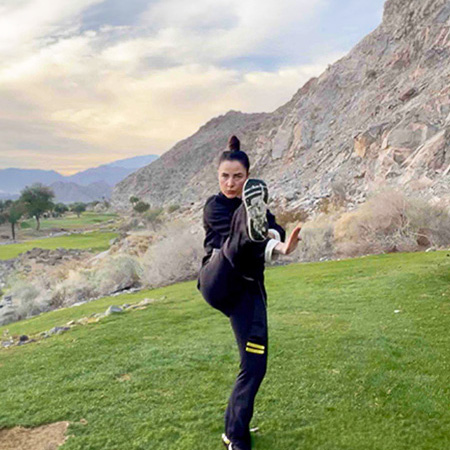
The contrast with Sil Lim Tao is immediately apparent. Where the first form is practised almost entirely from a stationary stance, Chum Kiu introduces body turning, stepping, kicks, and the coordinated use of upper and lower body in combination. The practitioner who has built a solid Sil Lim Tao foundation suddenly has the tools to apply those principles dynamically — in the context of real movement and real engagement ranges.
The Three Pillars of Chum Kiu
Body Turning (Pivoting) — Wing Chun's signature pivot is one of the system's most distinctive features. By rotating the body as a unified structure around the centreline, the practitioner generates significant force while simultaneously changing the angle of their structure relative to an incoming attack. The pivot turns a defensive movement into an offensive one. Chum Kiu trains this pivot in its correct structural context.
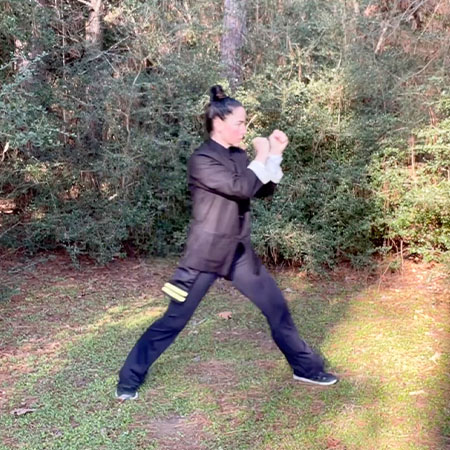
Stepping — The ability to move while maintaining Wing Chun's structural integrity is more demanding than it sounds. The stepping in Chum Kiu covers forward, backward, and lateral movement, each with specific structural requirements that maintain rooting and power generation throughout. Kicks — Wing Chun's kicks are low, direct, and structurally grounded — delivered from a stable base, targeting the lower body. Chum Kiu introduces the front kick, side kick, and sweeping kick in their correct structural and tactical context, as part of combined hand-and-foot sequences.
Simultaneous Attack and Defence
One of Wing Chun's most important principles — performing a defensive and an offensive technique in the same moment — is explicitly and systematically trained in Chum Kiu through combined hand-and-foot techniques. A kick that takes the opponent's balance while the hands engage their arms; a pivot that simultaneously deflects an attack and positions the practitioner for a counter. Chum Kiu is where Wing Chun becomes dynamic.
For structured expert instruction in Chum Kiu, Sifu Kendra Mahon's Chum Kiu Master Certification covers the complete form with step-by-step video instruction, examination, and official certification.