
Wooden Dummy Training - Beyond Pattern Repetition
The Muk Yan Jong, or wooden dummy, stands as one of Wing Chun's most iconic training tools, yet it's also one of the most misunderstood. Too many practitioners approach dummy training as mere pattern memorization, running through the traditional 108 movements as if reciting a poem without comprehension. The dummy, properly utilized, is actually a sophisticated training partner that develops specific attributes impossible to cultivate through partner work alone: consistency, structural testing, and the conditioning of bones and connective tissues.
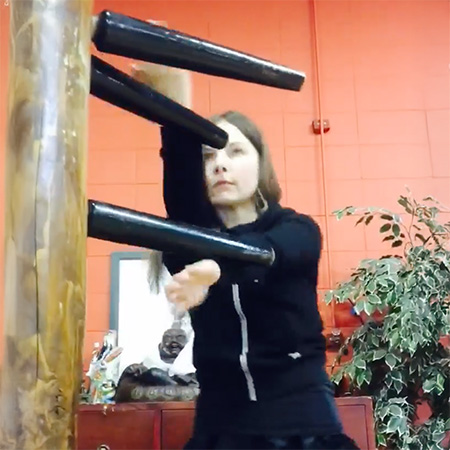
The primary value of the dummy lies in its unwavering honesty. Unlike a training partner who might accommodate your errors out of friendship or fatigue, the dummy provides consistent, impartial feedback. When your structure is weak, the dummy doesn't yield—your arms bounce back, or your stance collapses. This immediate physical feedback accelerates learning by creating a clear cause-and-effect relationship between proper technique and effective results. Over time, your body learns to self-correct based on this tactile feedback.
Many practitioners don't realize that the dummy's dimensions and arm positions aren't arbitrary—they're specifically calibrated based on human anatomy and common fighting ranges. The height of the upper arms typically aligns with a human's shoulder level, while the lower arm represents the common height of a midsection attack. The leg represents simultaneously controlling an opponent's lead leg. Training on a properly sized dummy develops spatial awareness and muscle memory for these critical ranges, so your techniques automatically target the correct heights without conscious thought.
The angles at which the dummy's arms protrude are equally significant. They're positioned to challenge the most common directional attacks that Wing Chun practitioners must deal with, training you to generate proper angles in their deflections and strikes. When you practice pak sau on the dummy, the angle forces you to turn properly—if you don't rotate from your center and merely extend your arm, it's too shallow and you slide off ineffectively, too steep and you waste energy fighting against the leverages advantage of the upper wooden arm.
Conditioning is another often-overlooked benefit of dummy training. The repeated impact of forearms against hardwood, when done progressively and with proper technique, stimulates bone density and strengthens connective tissue. This process, called "wolff's law" in sports science, causes bones to adapt and strengthen in response to loading. However, this must be approached with intelligent progression—excessive force on unprepared tissue leads to injury rather than adaptation. Begin with light contact and increase intensity gradually over months and years.
The dummy also serves as an excellent tool for developing "springy energy" or ging. When you strike the wooden arms with proper structure and relaxation, they'll vibrate slightly and that energy returns to your hand. Learning to redirect this returning force into your next technique creates the characteristic rapid-fire combinations Wing Chun is known for. This recycling of energy is difficult to practice with human partners because they absorb force with their bodies, while the dummy's rigidity provides immediate, honest feedback about your energy quality.
Common mistakes in dummy training include rushing through the form without attention to detail, hitting too hard before developing proper structure, and treating the dummy as an opponent to defeat rather than a teacher providing feedback. The dummy should never "win"—if you're bouncing off or struggling, you're not yet ready for that level of intensity. Slow down, focus on maintaining structure and proper angles, and let speed develop naturally from correct execution. Many practitioners would benefit more from one repetition done with perfect attention than a hundred done mechanically.
Advanced dummy practice involves breaking free from the set form entirely and using the dummy for spontaneous training. Work specific techniques or combinations that challenge your weaknesses. Practice single techniques hundreds of times until they become reflexive. Experiment with different rhythms, angles, and force levels. The dummy can be your most honest training partner if you approach it with the right mindset—not as a ritual to complete, but as a sophisticated feedback device designed to refine your Wing Chun to its highest expression. This shift from mechanical repetition to mindful, purposeful training transforms the wooden dummy from a simple striking post into an indispensable tool for developing authentic martial skill.